
Action for Denial of Paternity: Who May Bring It, Limitation Periods, and Common Mistakes
The action for denial of paternity is one of the most widely misunderstood types of case in family law, and one in which deadlines are most often missed. On one hand, there is a false sense of reassurance — "if the husband isn't the father, the presumption is rebutted anyway" — and on the other, uncertainty about who may bring the action and within what period, which frequently results in the right being lost at the very outset. This article addresses who may bring the action, how the limitation periods operate, and the mistakes commonly encountered in practice.
Why is the husband presumed to be the father of a child born during marriage?
Under Article 285 of the Turkish Civil Code (TMK), the husband is presumed to be the father of a child born while the marriage subsists, or within three hundred days of the marriage's dissolution. This is a presumption established by law; if it is thought not to reflect reality, it must be rebutted by bringing an action for denial of paternity. Without rebutting the presumption, saying that "he isn't the biological father anyway" produces no legal consequence — the civil registry does not change until the action for denial of paternity becomes final.
Who may bring the action?
The right to bring the action belongs to three persons: the husband, the child, and — since the Constitutional Court's decision of 26 July 2023 (E. 2023/37, K. 2023/140), which found the law's failure to grant this right to the mother to be contrary to the principle of equality and annulled that omission — the mother. These three may bring the action directly, in their own names.
In addition, where the husband dies before the period for bringing the action expires, is declared absent, or permanently loses the capacity of discernment, the husband's descendants, mother, father, or a person claiming to be the father may also bring an action in their own name. On behalf of a minor child, the action is brought by a guardian to be appointed for that purpose.
Limitation periods — where the right is most often lost
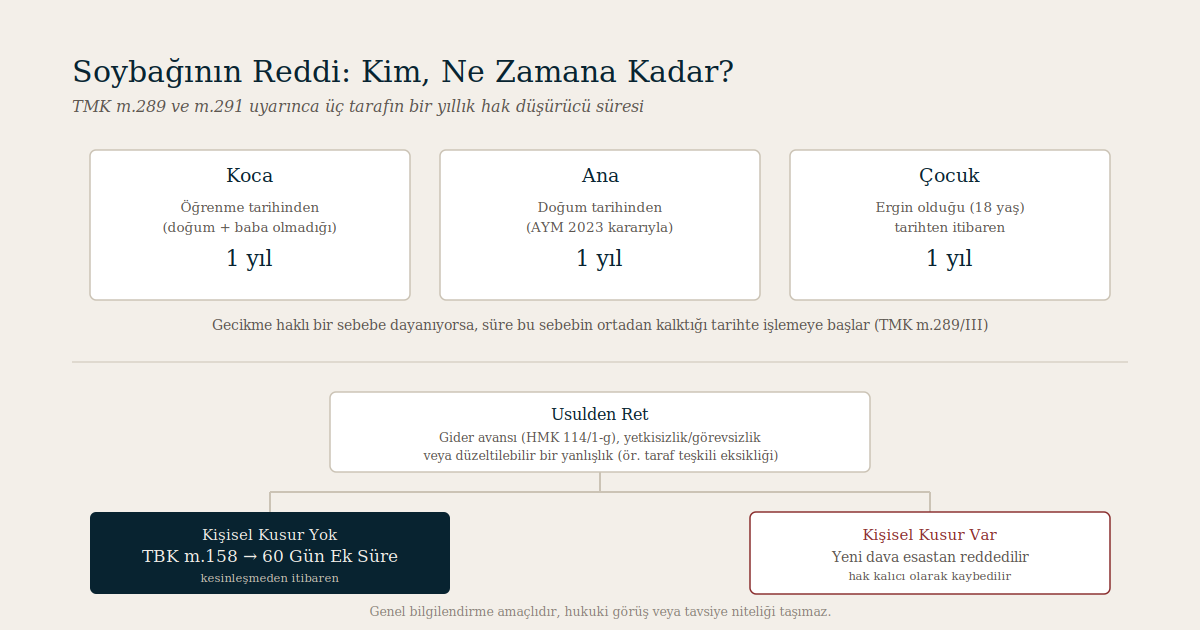
The husband must bring the action within one year of the date on which he becomes aware of the birth and of not being the father, or that the mother had sexual relations with another man during the conception period. The period begins to run not from the date of birth but from the date of becoming aware; however, there is settled case law to the effect that this awareness must be based not on an abstract suspicion but on concrete information leaving no room for doubt (for example, the result of a DNA test).
The mother must bring the action within one year of the birth; the child, within one year of reaching the age of majority. If the delay is based on a justifiable reason, the one-year period begins to run from the date that reason ceases to exist — that is, the period is not automatically extended; it must additionally be demonstrated and proven in the proceedings that the delay was based on a justifiable reason.
This limitation period is examined by the court of its own motion, without the parties needing to raise it; even if the defendant does not raise it as a defence, an action brought out of time is dismissed.
For persons who acquire the right to bring the action subsequently under Article 291 of the TMK (the husband's descendants, mother, father, or a person claiming to be the father), the period is one year from the date they become aware of the birth and of the husband's death, permanent loss of the capacity of discernment, or a declaration of his absence. For a guardian appointed for a minor child, the period is one year from the date the appointment decision is served on the guardian.
Burden of proof and the strength of the presumption
The burden of proof lies with the person bringing the action; there is a statutory presumption that the mother and the husband of a child born within the marriage are the biological parents, and the contrary of this presumption must be proven. Where the child was conceived during the marriage, the burden of proof is heavier: the claimant must show that it was factually impossible for the husband to be the father (for example, through concrete facts such as the husband being abroad, in prison, or medically established to be infertile during the period between 180 and 300 days before the birth), or that it is more likely that another man is the father. In the absence of such concrete facts, the most reliable means of proof is a DNA test; although the law does not make a DNA test mandatory, courts resort to it in practice.
Where the child was conceived before the marriage, or during a period in which the spouses were living separately, the presumption is considered weaker, and the claimant is not expected to meet such a heavy burden of proof.
Who should be the defendant, and does a defect in the parties cause the action to fail?
As a rule, the action is brought against the other spouse and the child; this is necessary because a decision that will change the civil registry concerns both of them as parties. However, the fact that the child or the other spouse has not been named as a defendant does not require the action to be dismissed on that ground — the court may complete the constitution of the parties of its own motion. A guardian must be appointed for the minor defendant child to represent them throughout the proceedings. Under settled practice, even where the action is upheld, court costs and attorney's fees are not awarded against the defendant child — the reasoning being that the child bears no fault for this outcome.
Acknowledgment and admission do not bind the court
Because actions concerning parentage closely concern public order, they are not actions left to the will of the parties. Neither the mother's nor the child's acceptance of the action, nor the mother's statement that she was with another man during the conception period, nor even the husband's express admission that he is not the father, binds the court on its own. The court may base its decision only on concrete, objective evidence: either that the husband's paternity was factually impossible because there was no sexual relationship during the period between three hundred and one hundred eighty days before the birth, or that the absence of parentage has been proven by a scientific method. Proof that the mother also had a relationship with other persons during the same period does not, by itself, exonerate the husband — for this to have any bearing, the impossibility of the husband's paternity must additionally be established.
The most common method of scientific proof today is the DNA test, but historically, blood-type incompatibility has also been used as a classic method of exclusion and still constitutes objective evidence. Under the ABO blood-type system, a child's blood type is limited to the genes that can be passed on by the mother and father; for example, if both the mother and the husband have blood type 0, it is accepted that a child born to this couple can only have blood type 0, and that a child with blood type A, B, or AB could not have been born to these parents. The finding of such an incompatibility constitutes strong evidence of the impossibility of paternity. In practice, however, courts today largely prefer to resolve the matter directly through a DNA test; this once again shows why proper constitution of the parties — correctly including the defendant mother and child in the proceedings — is so critical, since the sampling and cost procedures required for the test can only properly be requested from the actual parties to the action.
The sixty-day additional period after a procedural dismissal — and its limits
A serious risk encountered in practice is as follows: while the action is being pursued through counsel, notice requiring payment of an advance for expenses — for instance, to cover a costly DNA test — is served on counsel but is either not communicated to the client or is not paid within the period given. Under Article 114(1)(g) of the Code of Civil Procedure (HMK), payment of the advance for expenses that the claimant is required to make is treated as a condition for the action; where this condition is not fulfilled, the decision rendered is a procedural dismissal, given without any examination of the merits. Once this dismissal decision becomes final, no one may thereafter argue that it was in fact a dismissal on the merits — the nature of a final decision cannot be made the subject of dispute.
Where the limitation period has already expired by the date such a procedural dismissal becomes final, Article 158 of the Turkish Code of Obligations (TBK) offers a way out here — but this is not an automatic possibility available for every procedural dismissal. The article makes the additional period available only where one of three situations applies: the court's lack of jurisdiction or competence, a curable defect, or the action having been brought prematurely.
An example of lack of jurisdiction: under Article 283 of the TMK, actions relating to parentage are brought in the court of the place of residence of either party at the time of the action or at the time of the birth. If the action is brought in a court that matches neither of these two places of residence, and the opposing party raises a timely objection to jurisdiction, the court issues a decision of lack of jurisdiction; if the file is not requested to be sent to the competent court within the period following this decision, the action is deemed not to have been brought. This situation also falls within the scope of Article 158 of the TBK, and the sixty-day additional period may be relied upon.
An example of a curable defect: the mother or child, who should be named as defendants, are not named as parties, and the court, instead of completing the constitution of the parties of its own motion as it should, overlooks this and dismisses the action on procedural grounds for this deficiency. Where such a decision becomes final, the same additional period may also come into play.
The common feature of these three situations is that the expiry of the period must not stem from the claimant's personal fault. By contrast, where the claimant is pursuing the action without counsel, and despite being duly notified and warned fails to carry out the required step (for example, paying the advance for expenses), this is directly the claimant's own fault, and Article 158 of the TBK cannot be relied upon. An action brought again after the limitation period has expired is dismissed this time not on procedural grounds but on the merits — because the court is now examining, on the merits, a right that was not brought within the period. Once a dismissal on the merits becomes final, the right is lost permanently and irretrievably.
As a separate possibility, where the action was dismissed on the merits (rather than on procedural grounds) from the very outset, this decision, once final, also constitutes res judicata, and a new action on the same matter cannot be brought; where such a decision is encountered, what must be done is not to bring a new action but to pursue the available remedies — appeal and, where necessary, further appeal to the Court of Cassation — against that decision within the applicable period.
Other practical points concerning the process
The action is brought in the family court of the place of residence of either party, at the time of the action or at the time of the birth, under Article 283 of the TMK; in places where no family court has been established, it is brought in the civil court of first instance acting in the capacity of a family court. Where the action is pursued through counsel, because this action concerns rights that are strictly personal in nature, a power of attorney bearing a photograph and containing authority specific to this matter must be prepared. Because parentage is a matter closely concerning public order, courts generally also notify these actions to the public prosecutor's office and to the relevant civil registry/treasury authorities. The consequences of the action arise once the decision becomes final; no change is made to the civil registry before finality.
Why it must always be conducted with a lawyer
The consequences of an action for denial of paternity are not limited to a change in the civil registry. If the action does not become final, the child continues to be treated as the husband's child and continues to benefit from all the legal rights attached to the husband, such as inheritance, the reserved share, and maintenance. Those who miss the limitation period sometimes think "then I will bring a paternity action against the real father instead" — but this does not achieve the expected result. A child's parentage can be established with only one man at a time; unless the parentage with the husband is set aside by a final decision, a paternity action brought against another man cannot be upheld. The fact that anyone may bring any action is a different matter from that action being upheld and won — a subsequent paternity action cannot take the place of a denial-of-paternity right for which the limitation period has expired; such an action can be brought, but it will be lost because the existing parentage has not been set aside.
For this reason, it is critically important that the action be conducted from the very outset in the correct court, with the correct parties, and with all procedural obligations fulfilled without exception. Having the process handled through a lawyer prevents irreversible mistakes being made on points such as the limitation period, the constitution of the parties, and the conditions for the action, as discussed above.
In summary
The two most critical points in an action for denial of paternity are correctly determining when the period began to run, and ensuring that no step is skipped during the proceedings (particularly with regard to procedural obligations such as expenses and advances). Once the period has been missed, there is no way back other than the sixty-day additional period offered by Article 158 of the TBK — and there is no guarantee that this possibility will apply in every case.
This article has been prepared for general informational purposes. The course of action to be followed in an action for denial of paternity varies significantly depending on the specific facts of the case, the date on which the periods began to run, and the evidence in the file; nothing stated here constitutes legal advice or opinion.
For more detailed information, please contact us...