
Objecting to a Customs Administrative Fine: The Fifteen-Day Deadline, Settlement, and Common Mistakes
When a customs authority issues a notice of additional assessment or a fine, in most companies it goes first to accounting, then to the customs broker, and comes back weeks later with the answer "nothing could be done." Yet what actually matters in this process is not the amount of the fine, but the fifteen-day period that runs from the moment the notice reaches you. Choosing the right path within this period determines, in most files, both the amount ultimately payable and how long the process will take.
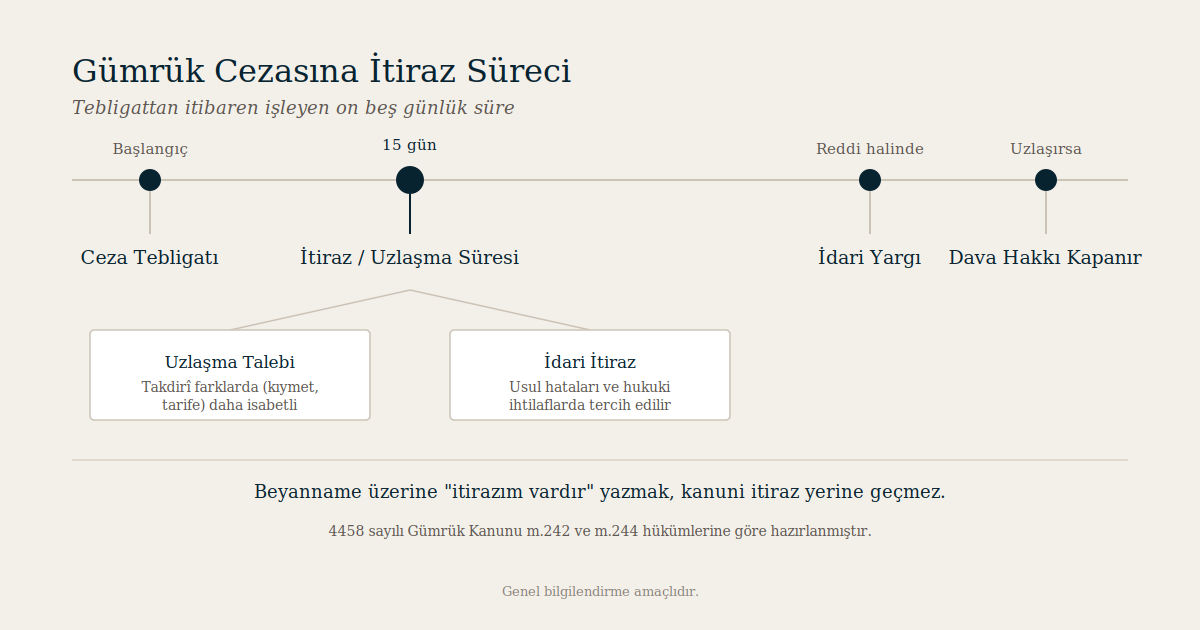
Where and when should the objection be filed?
Under Article 242 of Customs Law No. 4458, taxpayers may object, within fifteen days of notification, to customs duties, fines and administrative decisions notified to them, by way of a petition to a higher authority or, where there is no higher authority, to the same authority; objections that reach the administration are decided within thirty days and notified to the person concerned. In practice, this means applying to the relevant Customs and Foreign Trade Regional Directorate against an act carried out by a customs directorate.
The possibility of losing the deadline by applying to the wrong authority has been removed by law: if an objection petition is submitted to the wrong authority within the time limit, it is deemed to have been filed within the period, and the administration forwards it to the competent authority. In other words, when in doubt, the right course is not to wait, but to apply within the deadline.
Writing "I object" on the declaration is not an objection
This is the most costly misunderstanding in practice. Writing a note such as "I object" on the declaration to which the additional assessment or fine decision relates is not treated as an objection under Article 242 of the Customs Law. A taxpayer who makes this note, believing the matter has been dealt with, will find that once the fifteen days have passed, they have lost both the right to object and the right to seek settlement. An objection is a separate application, made by petition, to the competent authority.
Settlement: an underused, often more suitable route
Under Article 244, added to the Customs Law by Law No. 6111, it is possible to reach a settlement with the taxpayer or the person liable for the fine regarding customs duty receivables notified as a result of differences identified between the declaration and the determination made by the customs authority, and regarding fines provided for under the Customs Law and other laws. Requests for settlement are evaluated, depending on the amount of tax or fine concerned, by the Customs and Trade Regional Directorate Settlement Commissions or by the Central Settlement Commission.
An important point concerning how the periods run is this: a request for settlement, in respect of customs duties and administrative fines for which no objection has yet been filed, or for which an objection has been filed but not yet concluded, must be made within fifteen days of notification; where a request for settlement is made, the period for objecting or bringing an action is suspended, and if settlement does not take place or cannot be reached, the period resumes from where it left off — although if less than five days remain until the period expires, the period is extended to five days. In other words, applying for settlement does not forfeit the right to object or to sue, even if no result is achieved.
Settlement tends to be the appropriate choice where the dispute arises not from a legal issue but from a matter of discretion: differences of opinion in valuation, goods that fall close to the borderline in tariff classification, or quantity discrepancies between the declaration and the physical inspection. By contrast, where the administration's action is clearly unlawful and the matter is likely to set a precedent, it may be more appropriate to pursue the objection and litigation route to the end rather than settle. Once agreed, the settled amount becomes final and no action can be brought in respect of that matter; for this reason, a decision to settle should be considered not just in relation to the single file at hand, but in terms of its effect on every future declaration of the same kind.
Can an action be brought without first exhausting the objection route?
Although the wording of the law appears to present the objection as an optional right, the case law of the Council of State has established that the administrative objection route under Article 242 of the Customs Law must be exhausted before recourse is had to the courts. The practical consequence is clear: there is a real risk that an action filed directly, skipping the administrative objection stage, will be dismissed without the merits being examined. For this reason, the real battle in customs disputes is fought at the administrative stage; litigation should not be treated as a remedy for a missed administrative step.
If the objection is rejected, an action may be brought before the tax court for the place where the act was carried out, within thirty days. Where the fine is accompanied by a separate administrative act, such as the seizure of goods or the revocation of an import/export authorisation, the annulment of that act should be considered separately, as a claim independent of the monetary fine. If the administration fails to respond within thirty days, the implied-rejection provisions apply, and the period for bringing an action is calculated accordingly.
Grounds that actually work in an objection petition
Most customs disputes fall into a handful of categories, and the success of an objection depends on clearly identifying which of these categories the petition rests on.
Tariff classification comes first: which customs tariff statistical position the goods fall under directly determines the rate of duty, making it the most frequently disputed area. What matters here is not general statements, but the technical characteristics of the goods, their intended use, laboratory reports, and any binding tariff information that may exist.
Second is valuation. Where the administration does not accept the declared value and determines the value by another method, it should be examined whether the valuation methods were applied in the order prescribed by law.
Third are origin and preferential regime issues: the subsequent submission of a certificate of origin, formal deficiencies in the document, and the conditions for benefiting from preferential tariffs fall under this heading.
Fourth is procedural review, which is often the most productive. Whether the notice was served properly, whether the decision states its grounds, which remedies and time limits it indicates, and whether limitation periods have been observed — these are points on which a result can be obtained without reaching the merits at all.
Who is the party concerned: the taxpayer or the customs broker?
Because declarations in customs transactions are mostly made through a customs broker, the extent to which each party is responsible once a fine is notified is a separate source of dispute. Liability arising from the content of the declaration and liability arising from the representation relationship are different things, and it is decisive whether the broker acted as an indirect or a direct representative. Because this distinction affects both who the fine is properly addressed to and the recourse relationship between the broker and the company, it should be clarified before the objection petition is prepared.
Getting the process right
The worst thing to do with customs fines is to wait. The moment a notice is received, three things need to be done: establishing the exact date of notification, determining whether the dispute is legal or discretionary in nature, and making a conscious choice, on that basis, between objection and settlement. If these three are not completed within fifteen days, the options that remain narrow considerably, however strong the merits of the case may be. For other services in this area, see the Customs and Foreign Trade Law page.
This article has been prepared for general informational purposes. The path to follow in customs disputes varies according to the nature of the act and the specific facts of the case; nothing here constitutes legal opinion or advice. The legislation changes frequently and the information in this article is current as of the date of publication.
For more detailed information, please contact us...