
Transfer of Development Rights in Urban Transformation: What Changed with the February 2026 Regulation Amendment
A problem sometimes encountered in urban transformation is this: the development right (building right) carried by a parcel cannot be fully used on that same parcel because of the parcel's physical characteristics — its small size, shape, or location. How the transfer-of-development-rights mechanism that comes into play in such cases will operate within urban transformation projects has now been clarified by an amendment to the implementing regulation, published in the Official Gazette dated 4 February 2026 and numbered 33158. This article examines what this amendment means for co-owners.
What is transfer of development rights?
Transfer of development rights is an arrangement that allows the building right held by a parcel to be moved to another parcel instead of being used on the parcel itself. Following the general provision in the Zoning Law No. 3194, how this option would be used within urban transformation projects was a matter that needed separate clarification — because the situation in urban transformation differs from an ordinary zoning application: the parcel already has multiple owners, and a process requiring their consent is involved.
What did the 4 February 2026 amendment introduce?
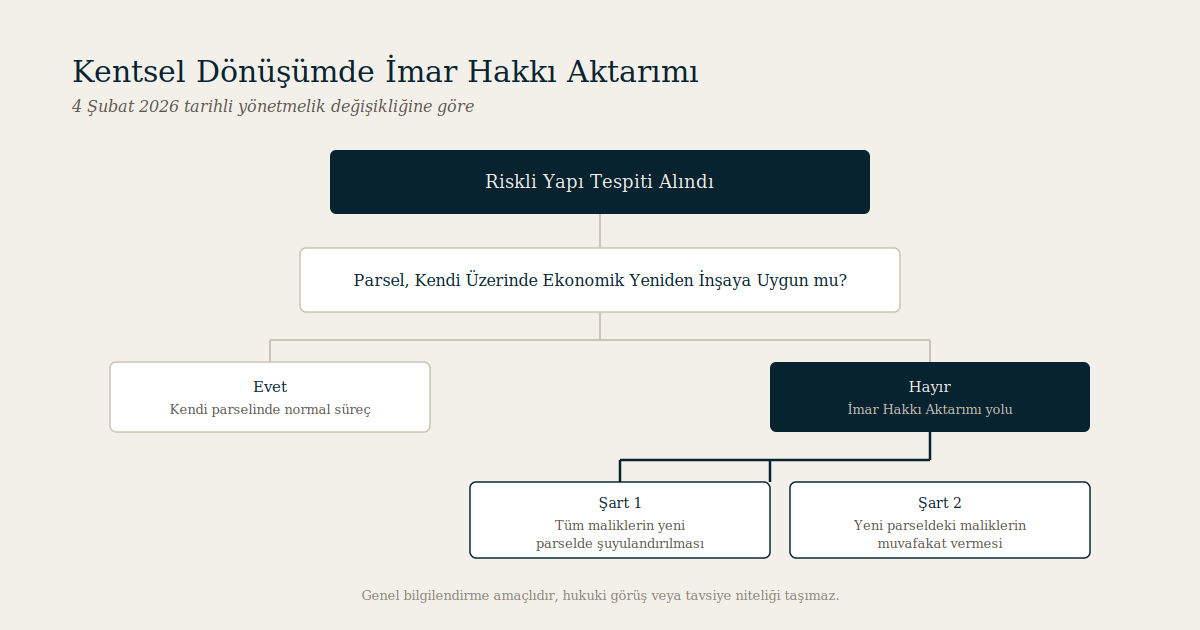
With the amendment made on 4 February 2026 to the Implementing Regulation of Law No. 6306 on the Transformation of Areas under Disaster Risk, it was explicitly regulated that the building right of the parcel on which an at-risk building is located may be transferred to another parcel through transfer of development rights, and under what conditions the urban transformation project will then be carried out.
Two conditions: consolidation and consent
The Regulation requires two conditions to be met together for the development right to be transferred to another parcel. The first is that all owners of the at-risk building must be consolidated into shared ownership on the new parcel to which the right is being transferred — that is, the shares of all owners on the old parcel must be reconstituted as co-ownership on the new parcel. The second is that if the new parcel already has other existing owners, those owners must also consent to the transfer. If either of these two conditions is missing, urban transformation cannot be carried out by way of transfer of development rights.
The practical consequence for co-owners
This arrangement is particularly important for co-owners who have obtained an at-risk building determination on a small or irregularly shaped parcel. Previously, it could be difficult to construct an economically viable building on such a parcel; transfer of development rights makes it possible for this right to be moved to a neighbouring or nearby parcel and used there. In exchange, however, the owner gives up sole control over their own parcel and enters into a co-ownership relationship with the other owners on the new parcel — for this reason, before deciding on a transfer, the arrangement to be made with the owners on the new parcel (such as share ratios and post-construction distribution) must be established very carefully.
In summary
Transfer of development rights offers a way out for owners who have obtained an at-risk building determination but cannot economically reconstruct on their own parcel, but this route cannot be used until the two conditions (consolidation and consent) are fulfilled. When such a transfer comes onto the agenda, establishing a sound legal relationship from the outset with the owners on the new parcel prevents disputes that might otherwise arise later. You can find more comprehensive information about the at-risk building determination and the general process that follows it in our article What Happens When Your Building Is Found to Be at Risk?
This article has been prepared for general informational purposes and is based on the amendment to the implementing regulation published in the Official Gazette dated 4 February 2026 and numbered 33158. The course of action to be followed in a specific case varies significantly depending on the circumstances of the parcel and its owners; nothing stated here constitutes legal advice or opinion.
For more detailed information, please contact us...