
The Contractor Delayed or Abandoned Construction Halfway: The Landowner's Options
In disputes caused by contractors, the most serious harm does not appear on the day the contract is signed, but after the delivery date has passed. The building has been demolished, the family is renting elsewhere, and construction has either never started or has stalled at the shell stage. At every meeting the contractor says "we're starting next month," months go by, and the landowner ends up with neither their home nor the ability to use their own land. The order in which steps are taken at this point directly determines the outcome. A co-owner's rights from the very start of the urban transformation process are covered separately in another article.
Start by looking at the contract
Everything that follows rests on the construction-in-return-for-land-share contract. Because this contract involves an undertaking to transfer ownership of real property, it must be executed in the form of a notarial deed; a contract drawn up as an ordinary private document is, as a rule, invalid, and this fundamentally changes the rights available to the parties.
The first thing to check in the contract is how the delivery date was set. What matters at this stage is whether the period runs from the granting of the building permit, from demolition, or from the date of the contract; whether there is a clause allowing the period to be extended due to weather conditions, changes in legislation, or administrative acts; and the amount of the penalty clause applicable in the event of delay and how it is calculated. In a contract with no penalty clause, proving the loss claimed for delay is considerably harder.
Default and formal notice
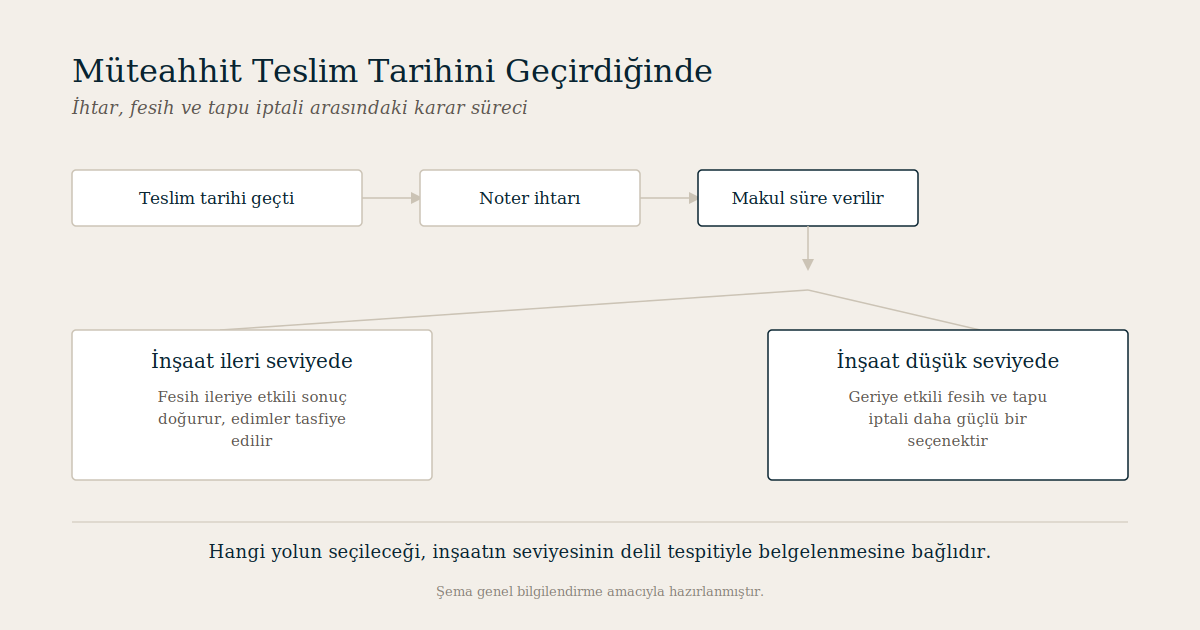
If the delivery date has passed and the work has not been completed, the first step is to send the contractor a properly drafted formal notice and allow a reasonable additional period. Skipping this step and filing suit directly creates a real risk that the case will be dismissed on the merits. Sending the notice through a notary matters for evidentiary purposes later on.
If the additional period given after the notice also passes without result, the landowner then has two basic options. The first is to keep the contract in force and claim the damage arising from the delay, together with the penalty clause if one exists; the second is to terminate the contract and seek annulment of any transfers already made on the title deed. Which option to choose is not a matter of preference but a technical decision that depends on how far construction has actually progressed.
Why the stage the construction has reached matters so much
In practice, the decisive criterion is the percentage of completion. Where construction has reached an advanced stage, terminating the contract with retroactive effect and seeking full recovery of the shares already transferred to the contractor may not produce the result one would want; in such cases, courts tend to treat the termination as having only prospective effect and instead work out a settlement of what each party has performed up to that point. By contrast, where construction has not begun at all, or has remained at a very low level, terminating the contract retroactively and annulling the title deed transfers made to the contractor is a far stronger option.
For this reason, the actual state of construction needs to be established before filing suit. A judicial determination of evidence requested from the court that will hear the case on the merits records both the condition of the construction at that point in time and whether the work carried out complies with the contract and the project. In litigation that may take years, having the situation documented as of the date the case was filed is the claimant's strongest asset.
If the contractor has transferred its shares to third parties
The worst-case scenario is one in which the contractor sells the land shares transferred to it to third parties, or places a mortgage on them. In that case, the dispute is no longer confined to the landowner and the contractor; the acquisitions of third parties presumed to be in good faith also come into play, and seeking annulment of the title deed becomes significantly harder.
This risk is managed through provisions built into the contract from the outset. Tying transfers of shares to the contractor to specific stages of construction, placing a notation prohibiting transfer and mortgage on the transferred shares, registering the contract itself on the title deed, and obtaining a performance bond, are all more effective than any legal step taken afterwards. An hour's work before the contract is signed can take the place of a lawsuit that would otherwise run for five years.
No occupancy permit, and defective work
Where the work is completed, if only late, the problem that tends to arise falls into two categories. The first is that the occupancy permit has not been obtained; in a building without one, even an owner who has actually moved in will run into lasting problems with utility connections, resale and mortgage financing, and this obligation rests, as a rule, with the contractor. The second is that the delivered unit does not comply with the materials specification attached to the contract. In the case of defective work, it is possible to claim the value of the missing or defective items, but here too notice periods run, and waiting after taking delivery results in loss of rights. A detailed handover record drawn up at the time of delivery is the basis for any objection raised afterwards.
In summary
In disputes caused by contractors, the landowner's greatest mistake is waiting. Every month that passes in reliance on promises made does not slow the running of the penalty clause; on the contrary, it allows the contractor's financial situation to deteriorate further, allows shares to pass to third parties, and makes it harder to prove the actual and legal state of the construction. Sending formal notice the moment the delivery date passes, and having the state of construction formally recorded, preserves the ability to decide later which path to take.
This article has been prepared for general informational purposes. The path to follow in disputes caused by a contractor varies significantly depending on the content of the contract and the stage the construction has reached; nothing here constitutes legal opinion or advice.
For more detailed information, please contact us...