
What Happens When Your Building Is Found to Be at Risk? What Co-Owners Need to Know About Urban Transformation
For most co-owners, urban transformation begins one day with a single notice posted at the entrance of the building. A process whose origin is not even clear suddenly concerns everyone's home, representatives of a contracting firm start showing up at the door, talk of "who got what" circulates among neighbours, and no one is quite sure what they are signing. Yet at every stage of this process, co-owners have concrete rights, deadlines that do not come back once missed, and documents that must be reviewed before any signature. Below, the process is explained in the order a co-owner will actually encounter it, without burying it in legal jargon.
How does the at-risk building determination start, and do my neighbours have to agree?
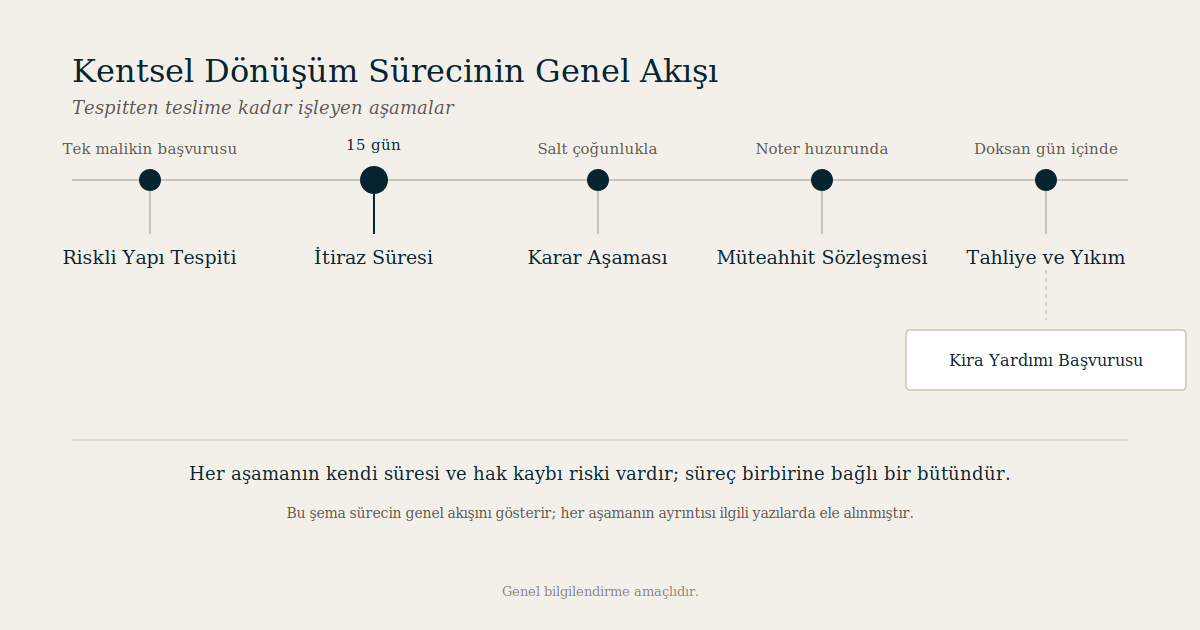
The determination of an at-risk building does not require the agreement of all co-owners. Any single owner in the building may, on their own, apply to one of the institutions licensed by the Ministry of Environment, Urbanisation and Climate Change to have the building assessed for risk. This process, which can be initiated without the other owners' knowledge, is in practice the actual starting point of the transformation, and in most apartment buildings this is the moment people first learn about it.
If the building is found to be at risk, the risk notation is reported to the relevant land registry office within ten working days at the latest and entered in the declarations section of the title deed. This notation means the legal status of the property has now changed; it has consequences ranging from sale transactions to obtaining credit. The land registry office also notifies the owners and other interested parties, and it is this notification that starts the objection period running.
Is there any point in objecting to the determination?
Yes, but the deadline is short. An objection to the at-risk building determination may be filed with the relevant directorate within fifteen days of notification, and the objection is examined by a technical committee made up of members appointed from universities and professional chambers. Once this period lapses, the determination becomes final, after which only the administrative courts remain as an option — and given how long court proceedings take and the fact that stay-of-execution orders are not always granted, this is, in practice, a far weaker position.
An objection tends to be meaningful where the technical report itself is deficient: measurements and samples not taken in accordance with proper procedure, a building that is in fact suitable for reinforcement, or a report that does not reflect the building's actual current condition. These, when raised before the determination becomes final, can make a real difference. The real risk is that owners let the fifteen days pass in silence, thinking "the building is old anyway, what's the point of objecting." The technical grounds an objection can rely on, where and how it is filed, and what to do if it is rejected, are covered separately in objecting to the at-risk building determination.
Does everyone have to sign? What does "simple majority" mean?
This is the most widely misunderstood point in urban transformation. For many years, a two-thirds majority of co-owners was required for a transformation decision. However, Law No. 7471, published in the Official Gazette on 9 November 2023 and entered into force on that date, reduced this threshold to a simple majority — that is, more than half. The same law also established the Urban Transformation Presidency as a separate institution. As a result, the process can now proceed even if more than one-third of the owners do not join the decision, and the belief that "if I don't sign, the building can't be transformed" no longer holds.
Here is how it works for an owner who does not join the decision. The decision taken and the offer made are notified to those who did not participate. If, within fifteen days of the date the notification is made or deemed to have been made, the offer is not reviewed or accepted, that owner's land share — at a value not lower than the market value to be determined by the Presidency — is sold to the other co-owners who reached the agreement, by way of an auction. Where a sale to fellow co-owners cannot be completed in designated risk areas or reserve building areas, the market value is paid by the Presidency, the relevant Administration, or TOKİ (Housing Development Administration), and the share is purchased. In other words, not signing does not stop the process — it means taking on the risk of losing one's own share. What an owner who does not wish to sign should do is not ignore the offer, but set out in writing, within the deadline, why the offer is inequitable.
How should meetings be held after the change of 4 February 2026?
An amendment to the Implementation Regulation made on 4 February 2026 rendered the procedures for holding meetings and taking decisions far more detailed and binding — a change that is still not widely known in practice, but whose consequences are serious. Under the new procedure, once the at-risk building determination becomes final, all co-owners are called to a meeting at the request of at least one of them. The call is made using Annex-12 of the Regulation, and is served either by posting it at the relevant muhtar's office and, if the building has not yet been demolished, at the building entrance or on a notice board for fifteen days, or by notarial notice. The same amendment also sets out in detail the validity requirements for meeting minutes and how a simple majority is to be established.
In practical terms, this means that a decision taken at a meeting held without following the proper call procedure is defective, however reasonable it may appear on its face. Meetings held without some owners' knowledge, with improperly kept minutes, or where it is unclear how the majority was calculated, can, if later challenged, send the whole process back to the start. For this reason, how the meeting was called, when the notice was posted, and who signed the minutes matter to every owner — whether or not they joined the decision.
What to check before signing a contract with the contractor
The biggest losses in transformation happen not at the risk-determination stage, but at the contract stage. Because a construction-in-return-for-land-share contract involves an undertaking to transfer ownership of real property, it is only valid if executed in the form of a notarial deed; a signature on a stamped piece of paper or a hand-delivered "protocol" provides no legal protection whatsoever.
As for the content of the contract, the most critical point is that the unit to be delivered to you must be individually identified by its independent-section number, floor and square metreage on the condominium project. Phrases such as "an equivalent unit will be provided" will not protect you if a dispute arises. It is equally important that the delivery date be stated explicitly, that the amount of the penalty clause applicable in the event of delay be specified along with how it is calculated, that it be shown who will pay the rent assistance, for how long and in what amount, and that the materials to be used be attached to the contract as a separate specification. Provisions restricting the contractor's ability to transfer the land shares it receives to third parties or to place a mortgage on the land, together with a performance bond, may be your only real protection against the work being left unfinished. It must also be stated in writing which party bears the risk of the permit not being obtained or of a change in the zoning status.
The problem encountered most often in practice is that promises made verbally during negotiations never make it into the contract. Which party will keep any grants or subsidised credit, how the deduction for the planning partnership share will be reflected, and how common areas and parking will be shared, are matters that are freely discussed in early meetings and just as easily denied later; no promise that is not written into the contract can be proven afterwards. Equally, it is a basic rule never to sign before seeing the building permit and the approved architectural project. A contractor's approach of "let's agree first, we'll show you the project later" means you do not yet know what you will actually be getting.
What happens if the contractor delays or leaves the work unfinished after the contract is signed is dealt with separately in the options available to the landowner.
Rent assistance and other support
Rent assistance may be provided to owners and tenants who are required to relocate because of an at-risk building, under the procedures and principles set by the Urban Transformation Presidency. Because the amount and duration of the assistance are updated every year, it is necessary to check the Presidency's current announcements before applying. It is also a frequent source of confusion that rent assistance and the rent payment the contractor undertakes in the contract are different things, and one does not replace the other; it is advisable to make this distinction explicit in the contract.
Not missing deadlines matters more than anything else
Urban transformation legislation has changed repeatedly since 2023, and the common thread running through these changes has been the acceleration of the process. Speed works against an owner who cannot decide, or who acts too late. Fifteen days to object to the determination, fifteen days to evaluate an offer, the period given for demolition — which cannot exceed ninety days — none of these can be recovered once they pass. For this reason, from the moment transformation starts being discussed in a building, checking your title deed record, your land share and the building's zoning status — before anyone has signed anything — is worth more than any intervention made afterwards.
This article has been prepared for general informational purposes. Urban transformation processes vary significantly depending on the location of the property, its zoning status, and the legal relationship among the co-owners; nothing here constitutes legal opinion or advice on any specific matter. The legislation changes frequently and the information in this article is current as of the date of publication.
For more detailed information, please contact us...