
If Your Investment Fund Has Entered Liquidation or Been Suspended From Trading: The Investor's Options
The recent decision by the Capital Markets Board to suspend trading in, and place into liquidation, investment funds belonging to several portfolio management companies has left many people whose money is in these funds facing the same question: what happens to my money now? This article does not contain any assessment of any company or individual — the investigation is ongoing and the allegations have not yet been finalised. Its purpose is to explain, in general terms, the legal avenues available to an investor in such a situation.
Why isn't the fund's asset pool simply lost?
Under the first paragraph of Article 53 of the Capital Markets Law, the assets of an investment fund are separate from the assets of the portfolio management company that establishes and manages it. This principle of separation is the investor's most fundamental safeguard: even if the portfolio management company itself falls into financial difficulty or becomes subject to an investigation, the assets within the fund are protected against that company's creditors and cannot be seized for the company's own debts. Accordingly, the assumption that "an investigation has been opened into the company, so my money is completely gone" is often incorrect; the real issue is what the assets within the fund are actually worth, and when and how they can be accessed.
Suspension from trading and liquidation are different things
Suspending a fund from trading means that its units cannot temporarily be bought or sold; this is a measure the Capital Markets Board uses to protect the orderly functioning of the market, and it does not necessarily mean the fund will be liquidated. A liquidation decision is a further stage: it is the process of terminating the fund, converting the assets within it into cash, and distributing them to the holders of participation units. The Board may determine the method of liquidation itself. The practical consequence for the investor is this: once the liquidation process begins, the investor does not receive the value of their units immediately, but as the liquidation proceeds and based on the fund's actual net asset value — this process can take weeks, and in some cases longer.
When does the portfolio management company's liability come into play?
The decisive point for the investor here is whether the loss stems from ordinary market risk or from the portfolio management company's fault. Under Article 34 of the Communiqué on Portfolio Management Companies, a portfolio management company is directly liable to its client for losses arising from transactions contrary to the agreement, the fund's articles of association, the prospectus, capital markets legislation, or general provisions, and from acts contrary to its duties of care and loyalty; this liability cannot be excluded by agreement.
The practical distinction is as follows: a fund losing value because the market as a whole has fallen is a consequence of ordinary investment risk and does not, by itself, give rise to a claim for damages. By contrast, if the fund's value was artificially inflated by the company's own transactions (for instance, as alleged, by artificially inflating the price of a share included in the fund's portfolio) and the resulting loss stems from the subsequent collapse of that artificial value, arising from the company's breach of its duties of care and loyalty, direct liability for that loss may come into question.
Avenues available to the investor
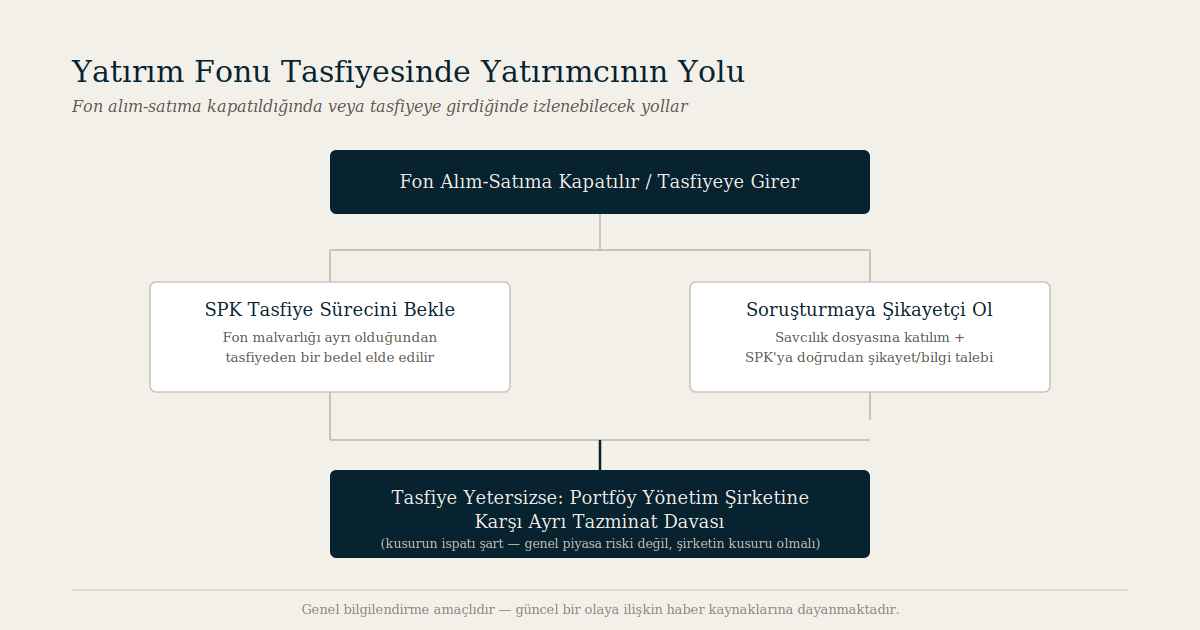
The investor has several avenues available that are not mutually exclusive. First, the liquidation process to be determined by the Capital Markets Board is awaited; if the amount obtained from the fund at the end of this process falls short of the investor's original investment, a separate action for damages can be brought against the portfolio management company for the difference — this is not a right limited to what is obtained through liquidation, and liquidation and a claim for damages do not substitute for one another.
Second, if the public prosecutor's office is already conducting an investigation into the portfolio management company's transactions, the investor may join that investigation as a complainant and, if criminal proceedings are brought, participate as an intervening party in the public prosecution; this does not remove the need to bring a separate civil action, but it does provide the opportunity to make use of the evidence in the criminal file.
Third, a direct complaint and request for information can be submitted to the Capital Markets Board; the Board's findings in the administrative process (such as findings of fault or of a breach of legislation) may constitute strong evidence in a subsequent claim for damages.
Time limits require care
General limitation periods for claims for damages begin to run, and these periods are calculated from the date on which the loss and the person responsible for it became known. Waiting for the liquidation process to conclude does not, in itself, eliminate the right to bring a claim for damages, but waiting for the outcome of the liquidation in order to establish the exact amount of the loss is often the practically correct approach — the balance between the two must be struck according to the specific facts of the case.
In summary
A fund being suspended from trading or placed into liquidation does not mean the investor's money has been entirely lost; the principle of separation of the fund's assets provides a protective basis here. But where the amount obtained from liquidation is insufficient, being able to show that the loss stems from the portfolio management company's fault is the central factor determining the success of a separate claim for damages — for this reason, keeping account statements, the fund's transaction history, and correspondence with the company together from now on will be the most valuable material for any future claim.
This article has been prepared for general informational purposes, is based on news sources relating to a current event, and does not contain any allegation, assessment, or accusation against any natural or legal person — the investigations referred to are ongoing and no final court decision has been rendered. The course of action to be followed in a specific case depends on the terms of the agreement and the circumstances involved; nothing stated here constitutes legal advice or opinion.
For more detailed information, please contact us...